Our Courses
Courses
Courses
Filters
Master the Modern Workplace: OSA Essentials for Managers and Leaders
Ensure compliance with AFS 2015:4 while building a resilient, high-performing organizational culture.
In today’s fast-paced professional landscape, the "social" work environment is just as critical as physical safety. This course provides a comprehensive deep-dive into the Organizational and Social Work Environment (OSA) regulations. Designed for managers, HR professionals, and safety representatives, our OSA Essentials program moves beyond theory to give you the practical tools needed to prevent unhealthy workloads and manage workplace dynamics effectively.
What You Will Learn:
The Legal Framework: A clear breakdown of the Swedish Work Environment Authority’s regulations (AFS 2015:4).
Workload Management: How to identify, assess, and counteract unhealthy physical and mental workloads.
Victimization & Harassment: Proactive strategies for preventing and handling social conflicts and bullying.
Goal Setting & Resources: Aligning organizational demands with the resources available to your team.
The Manager’s Role: Understanding your specific legal responsibilities and the "duty of care."
Course Features:
Digital Excellence: Powered by the QualsDirect platform for a seamless, self-paced learning experience.
Expert Assessment: Your progress is monitored and marked by industry-certified HSE assessors.
Evidence of Competence: Receive a formal certificate upon completion to meet your company's regulatory requirements.
Flexible Access: Study anytime, anywhere, with our mobile-friendly student portal.
Who is this for?
New and experienced Managers/Supervisors.
HR Business Partners and Directors.
Safety Representatives (Skyddsombud).
Business owners seeking to fulfill their legal employer obligations.
Precision Prevention: Hazard Identification & Risk Assessment (HIRA)
Stop accidents before they happen. Develop the analytical skills to identify hidden dangers and implement effective controls.
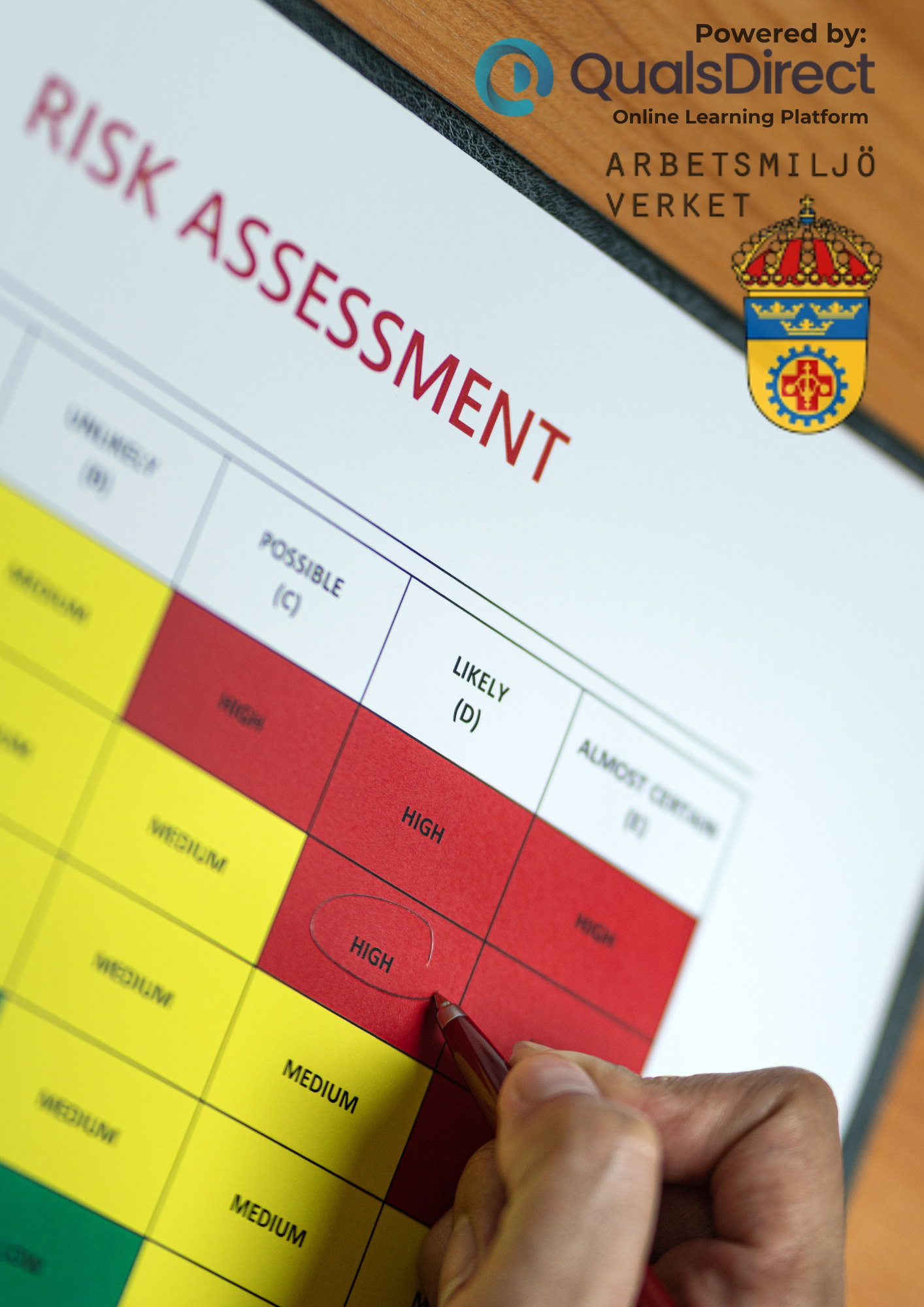
Risk assessment is the most important tool in any safety professional's kit. It is the bridge between "knowing" the law and "applying" it on the shop floor or in the office. This course moves beyond basic checklists to teach you a professional, systematic approach to hazard identification. Whether you are dealing with heavy machinery, chemical risks, or ergonomic stressors, our HIRA program gives you a universal framework to quantify risk and prioritize your safety budget where it matters most.
What You Will Learn:
The Hazard vs. Risk Distinction: Understanding the fundamental definitions to ensure accurate reporting.
The Identification Process: Techniques for spotting physical, chemical, biological, and psychosocial hazards in any environment.
Qualitative vs. Quantitative Assessment: How to use Risk Matrices (Probability x Severity) to rank dangers.
The Hierarchy of Controls: Moving from simple PPE to more effective solutions like Elimination, Substitution, and Engineering controls.
Dynamic Risk Assessment: How to assess changing environments on the fly (critical for field work and construction).
Compliance Documentation: Creating risk assessment records that meet AFS 2001:1 standards for Swedish inspections.
Course Features:
Interactive Risk Mapping: Use the QualsDirect platform to perform "virtual site audits" and identify hazards in high-resolution scenarios.
Standardized Templates: Get access to the "Gold Standard" Risk Assessment forms used by top-tier HSE consultancies.
Professional Validation: Your completed risk assessments are reviewed by our assessors to ensure they meet legal "sufficiency" standards.
B2B Integration: Learn how to roll out a standardized HIRA process across your entire organization.
Who is this for?
Safety Officers and HSEQ Specialists.
Site Supervisors and Project Managers.
Team Leaders responsible for daily "Toolbox Talks."
Maintenance and Engineering personnel.
From Crisis to Clarity: Professional Incident & Accident Investigation
Master the art of Root Cause Analysis to prevent recurrence and strengthen your safety culture.
An accident is a failure of the system, not just the individual. When an incident occurs, the quality of the investigation determines whether the organization learns or repeats the mistake. This course provides a structured, methodical approach to investigating workplace accidents, near-misses, and occupational illnesses. We move beyond "what happened" to discover "why it happened," giving you the skills to implement corrective actions that actually work.
What You Will Learn:
Immediate Response: How to secure an incident scene and manage the initial "golden hour" of data collection.
Evidence Gathering: Effective interviewing techniques and how to document physical and digital evidence.
Root Cause Analysis (RCA): Utilizing proven methodologies (such as the 5 Whys and Fishbone Diagrams) to find the source of the failure.
Legal Reporting Requirements: Understanding when and how to report to the Swedish Work Environment Authority (Arbetsmiljöverket) and Social Insurance Agency (Försäkringskassan).
Action Planning: Developing and tracking SMART corrective actions to ensure the risk is permanently mitigated.
Human Factors: Understanding the role of stress, fatigue, and organizational culture in workplace incidents.
Course Features:
Scenario-Based Learning: Practice your investigation skills on real-world HSE case studies via QualsDirect.
Expert Feedback: Submit your investigation reports for review by our senior safety lead assessors.
Regulatory Alignment: Fully compliant with the investigation requirements set out in SAM AFS 2001:1.
Downloadable Toolkits: Receive investigation templates, interview guides, and report formats you can use immediately in your business.
Who is this for?
HSEQ Managers and Safety Officers.
Department Heads and Team Leaders.
Union Safety Representatives (Skyddsombud).
HR Professionals involved in occupational health and safety.
The Foundation of Safety: Systematic Work Environment (SAM) Fundamentals
Master the 'Investigate, Assess, Act, and Follow-up' cycle to ensure a compliant and thriving workplace.
Systematic Work Environment Management (SAM) is the cornerstone of Swedish labor law (AFS 2001:1). It is the continuous process of identifying and managing physical, psychological, and social risks before they lead to ill health or accidents. This fundamental course is designed to strip away the complexity of the regulations, giving you a clear, step-by-step roadmap to building a robust safety culture that satisfies both the law and your employees' wellbeing.
What You Will Learn:
The Four Pillars of SAM: A deep dive into the mandatory cycle: Investigation, Risk Assessment, Action Planning, and Control.
Allocation of Tasks: How to effectively delegate work environment tasks within your organization.
Risk Assessment Tools: Practical methods for identifying hazards in both office and industrial settings.
Documentation Requirements: What you must have in writing to pass an inspection by the Work Environment Authority (Arbetsmiljöverket).
Annual Reviews: How to evaluate your SAM system once a year to ensure it remains effective.
Course Features:
QualsDirect Integration: Complete your theory modules and documentation exercises through our secure digital platform.
HSE Expert Markings: Get direct feedback on your risk assessment exercises from our experienced HSE assessors.
Compliance Ready: Our curriculum is specifically mapped to the latest Swedish Work Environment standards.
On-Demand Flexibility: Perfect for busy professionals who need to balance training with daily operations.
Who is this for?
Business Owners and CEOs of small to mid-sized enterprises.
Appointed Safety Representatives (Skyddsombud).
Team Leads and Department Managers.
Anyone new to the Swedish Work Environment Act.
SAM Management & System Implementation
Go beyond compliance. Build a high-performing safety management system that integrates seamlessly with your business operations.
Knowing the regulations is the first step; building a living, breathing management system is the real challenge. This advanced course is designed for those responsible for the architecture of the work environment within their organization. We move past the basics of SAM to focus on implementation, scaling, and cultural integration. Learn how to design a system that doesn't just sit in a binder, but actively drives organizational efficiency and protects your most valuable asset: your people.
What You Will Learn:
System Architecture: How to design a SAM framework that fits your specific organizational structure and industry.
The Managerial Mandate: Advanced techniques for the formal "Allocation of Tasks" and ensuring accountability at every leadership level.
Integrating OSA & SAM: Merging social and organizational factors into your physical safety system for a holistic approach.
Strategic Risk Analysis: Moving from individual hazards to high-level organizational risk mapping.
Audit & Evaluation: How to conduct internal audits and prepare for external inspections by the Swedish Work Environment Authority.
Safety Culture & Change Management: Tools to move your workforce from "having to" to "wanting to" work safely.
Course Features:
Implementation Toolkit: Access to templates and frameworks via QualsDirect that you can adapt directly for your company.
Consultative Feedback: Our assessors provide strategic critiques of your system-building exercises.
B2B Scalability: Designed to help you standardize safety across multiple departments or geographical locations.
Executive Certification: A certificate that demonstrates your competence in managing complex HSE systems.
Who is this for?
HSEQ Managers and Coordinators.
Operations Directors and Senior Management.
Professional Work Environment Consultants.
HR Directors responsible for organizational design.
The Full Construction Coordinator Suite: BAS-P & BAS-U Combined
From the first sketch to the final brick. Secure your dual certification and lead every phase of the construction work environment.
Why choose between planning and execution? For project leaders who manage a build from start to finish, holding both BAS-P and BAS-U certifications is the industry standard. This comprehensive bundle combines the strategic foresight of the Planning phase (BAS-P) with the tactical, on-site coordination required during Execution (BAS-U). By completing both modules, you ensure a seamless transition of safety documentation and a higher level of legal protection for both the developer and the contractors.
What’s Included in the Bundle:
Full BAS-P Curriculum: Focus on AFS 1999:3, the "Byggherre" responsibility, and creating the initial Work Environment Plan (AMP).
Full BAS-U Curriculum: Focus on site-level coordination, managing subcontractors, and performing mandatory safety rounds.
Integrated Knowledge: Learn how the decisions made in the BAS-P phase directly impact the safety and budget of the BAS-U phase.
Dual Certification: Upon completion, you will receive two distinct certificates recognized across the Swedish construction sector.
Why Bundle?
Streamlined Learning: Access all materials through a single QualsDirect dashboard.
Unified Assessment: Work with the same HSE assessor across both certifications for consistent feedback.
Cost & Time Efficiency: Simplify your professional development by tackling the full legal framework in one structured path.
Who is this for?
Construction Project Managers.
Self-employed Contractors and Consultants.
Site Managers transitioning into Project Planning.
Developers who want a 360-degree understanding of their legal liabilities.
Designing for Safety: BAS-P Certification
Master the legal requirements for the planning and design phase under the Swedish Work Environment Act.
Safety starts long before the first stone is laid. BAS-P (Byggarbetsmiljösamordnare för planering och projektering) is responsible for coordinating work environment issues during the design and planning stages of a construction project. This course focuses on how to identify and eliminate structural risks early, ensuring that the transition from the drawing board to the construction site is seamless, compliant, and safe.
What You Will Learn:
The Developer’s Responsibility: Understanding the ultimate liability of the "Byggherre."
Risk Assessment in Design: Techniques for identifying risks during the architectural and technical planning phases.
The Work Environment Plan (AMP): How to establish the initial safety documentation for the project.
Legal Coordination: Managing the interaction between different consultants and designers to prevent conflicting safety interests.
AFS 1999:3: In-depth study of the specific regulations governing construction work.
Who is this for?
Architects and Technical Consultants.
Design Managers and Project Planners.
Developers (Byggherrar).
Safety on the Ground: BAS-U Certification
Lead the execution phase with authority, ensuring on-site coordination and strict regulatory compliance.
Once the project moves to the site, the responsibility shifts to BAS-U (Byggarbetsmiljösamordnare för utförande). This course is designed for those who oversee the daily operations of a construction site. You will learn how to coordinate multiple contractors, manage high-risk activities, and maintain a living Work Environment Plan that adapts to the realities of a dynamic building project.
What You Will Learn:
Site Coordination: Managing the intersection of different trades and subcontractors to prevent accidents.
Updating the AMP: Keeping the Work Environment Plan current as the project evolves.
High-Risk Work: Procedures for scaffolding, heavy lifting, and electrical work.
Inspections & Documentation: How to conduct and document daily safety rounds and incident reports.
Contractor Management: Ensuring all parties on-site follow the established safety rules and Swedish law.
Who is this for?
Site Managers and Foremen.
Contractors and Subcontractors.
Construction Project Managers.
Get qualified while seamlessly doing your job
No formal examinations or Summative Assessments
Improved career opportunities
Management level qualification
Globally recognized
PROQUAL Regulatory body
IOSH Membership Opportunity
Overview
The NVQ Level 3 Certificate in Occupational Health and Safety focuses on enhancing candidates’ knowledge and the necessary skills to effectively manage routine workplace tasks from an occupational health and safety perspective. This course is regulated and issued through PROQUAL awarding body
Program Comparative and Alternatives
Level 3 NVQ Certificates and NEBOSH Certificates are equivalent standards. Both the level 3 NVQ in occupational health and safety and the NEBOSH level 3 certificate qualifications are rated equally on the qualifications framework.
Who is this NVQ certificate designed for?
This NVQ Level 3 certificate in health & safety primarily targets mid-level managers, supervisors, and workers already handling Health and Safety responsibilities as part of their daily work routines and processes.
The primary goal of this NVQ certificate course is to enhance employees’ fundamental understanding, knowledge, and proficiency in Occupational Health and Safety.
This qualification is suitable for those working anywhere in world!
A Level 3 NVQ serves as an excellent qualification for individuals seeking career advancement. For further progress, we recommend advancing to a Level 6 NVQ following your success in this program.
Achieve your ProQual NVQ certification via our online learning platform, equipped with resources to assist your advancement and facilitate the accumulation of necessary evidence.
Successfully completing the ProQual Level 3 NVQ Certificate in Occupational Health and Safety Practice requires active employment in a position with substantial health and safety responsibilities, allowing for the effective development of your evidence portfolio.
Entry Requirements:
While there are no specific formal entry prerequisites for NVQs, the following criteria should be met to ensure strong foundations:
A proficient level of English language.
Employment in a role involving health and safety responsibilities.
Examinations
There are no formal exams (summative assessments) associated with this course. Assessment relies solely on the submission of your work-based evidence and documents to validate successful implementation strategies.
Initial Assessment on Candidate Application
Before enrolling in the course, our administrations office will request completion of an initial assessment to ensure suitability for the program.
Training & Guidance Support:
Included in this course where our assessors will offer the necessary guidance for you to successfully complete this Qualification.
A/650/6127 Investigate and evaluate health and safety incidents and complaints in the workplace
Y/650/6126 Ensure responsibility for actions to reduce risks to health and safety
F/650/6129 Develop procedures to safely control work operations
F/601/9354 Monitor procedures to safely control work operations
F/601/6633 Promote a culture of health and safety in the workplace
H/601/6687 Conduct a health and safety risk assessment of the workplace
D/650/6128 Make sure actions in the workplace aim to protect the environment
M/601/6837 Review health and safety procedures in the workplace
NVQ Level 6 Diploma in Occupational Health and Safety Practice – Course Overview
The NVQ Level 6 Diploma in Occupational Health and Safety Practice is a globally recognised qualification designed for professionals responsible for managing health and safety within the workplace. Equivalent to a bachelor’s degree, this course is tailored for individuals in supervisory or managerial roles who are looking to enhance their competence and leadership in health, safety, and environmental (HSE) practices.
Unlike traditional academic courses, the NVQ Level 6 is competency-based, meaning candidates are assessed on their ability to perform in real work environments. There are no written exams; instead, learners build a portfolio of evidence demonstrating their practical application of health and safety principles in their day-to-day roles.
Course Level
Level 6, Equivalent to a University level recognized Bachelors Degree
Course duration / eLearning access
24 months
Learner Average completion time
7-12 Months
Professional Membership Opportunity
Certified Membership (CertIOSH) of the Institution of Occupational Safety and Health, Leading to Chartered Membership (CMIOSH)
Course Content and Structure
The qualification covers a broad range of essential topics, including:
Developing and implementing health and safety policies
Risk assessment and risk management strategies
Promoting a positive health and safety culture
Investigating incidents and implementing corrective actions
Ensuring compliance with legal and regulatory requirements
Monitoring and reviewing health and safety performance
Leadership and communication in HSE management
Candidates are required to demonstrate their knowledge and competence through documented evidence such as reports, risk assessments, method statements, audits, and reflective accounts.
Assessment Method
Assessment is carried out through:
Portfolio of workplace evidence
Professional discussions with an assessor
Observations (where applicable)
Witness testimonies from colleagues or supervisors
This flexible approach allows learners to complete the qualification alongside their full-time roles, applying learning directly to real-life scenarios.
Benefits of the Qualification
Achieving the NVQ Level 6 Diploma offers several key benefits:
Enhances professional credibility and recognition within the industry
Provides a pathway to Graduate Membership (GradIOSH) and eventually Chartered status (CMIOSH)
Strengthens leadership capability in managing workplace health and safety
Demonstrates a strong commitment to continuous improvement and safe working practices
The NVQ Level 6 Diploma in Occupational Health and Safety Practice is an ideal qualification for experienced professionals seeking to formalise their skills and progress their careers. By focusing on practical competence and real-world application, it ensures that learners are fully equipped to lead and influence health and safety performance at an organisational level.
Career positions & opportunities
• Health and Safety Manager
• Health and Safety Consultant
• Health and Safety Officer
• Risk Manager
• Compliance Manager
• Safety Engineer
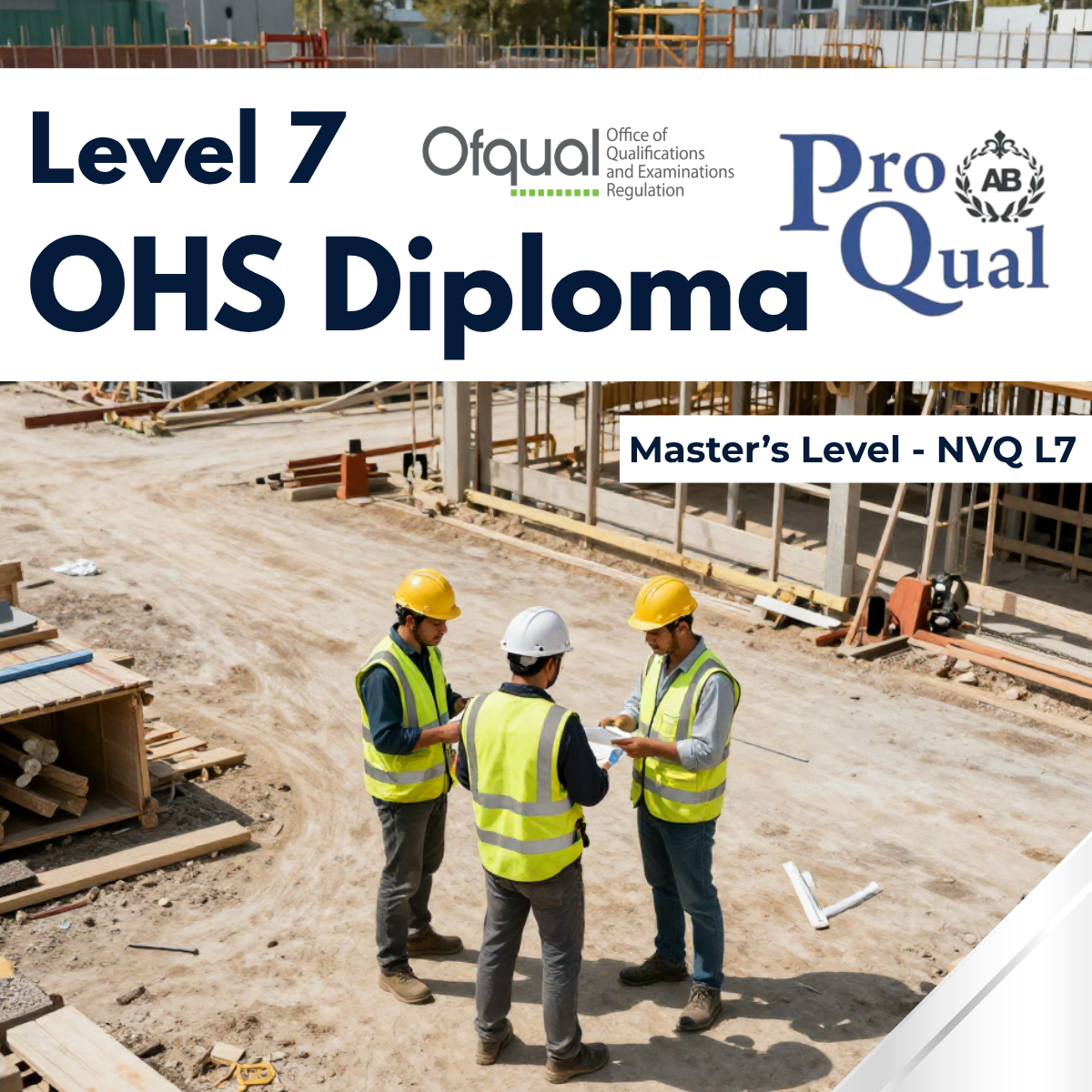
The NVQ Level 7 Diploma in Strategic Health and Safety Leadership and Management is a prestigious, master’s level qualification designed for senior professionals responsible for shaping organisational health and safety strategy. It is aimed at directors, senior managers, and HSE leaders who influence policy, culture, and long-term risk management at the highest level.
This qualification moves beyond operational safety management and focuses on strategic leadership, organisational governance, and the integration of health and safety into overall business objectives.
Like other NVQs, it is entirely competency-based. Candidates are assessed on real-world performance within their organisation, building a comprehensive portfolio of evidence that demonstrates their ability to lead, influence, and deliver measurable improvements in health and safety outcomes.
Course Level
NQF Level 7, Equivalent to a University master’s degree
Course duration / eLearning access
24 months – Licensed Access
Course Start Dates
Any time
Average completion time
12 Months
Assessment Style
Competency based assessment, Online evidence submission
Course Content and Focus Areas
The NVQ Level 7 covers advanced topics such as:
Strategic development of health and safety management systems
Embedding health and safety within organisational culture and governance
Leadership influence at board and executive level
Risk-based decision making aligned with business objectives
Corporate responsibility and ethical leadership
Monitoring, auditing, and continuous improvement at a strategic level
Crisis management and organisational resilience
Assessment Approach
Assessment is conducted through:
A detailed portfolio of strategic-level evidence
Professional discussions with assessors
Reflective accounts demonstrating leadership impact
Witness testimonies from senior stakeholders
Benefits of NVQ Level 7
Recognised as a master’s level qualification
Supports progression to Chartered Membership (CMIOSH)
Strengthens executive-level leadership and influence
Enhances credibility in boardroom and stakeholder environments
Demonstrates the ability to align safety with business strategy
The Doctrine of Strategic Risk and Executive Leadership (DSREL) is the prestigious awarding Diploma, developed as a natural progression beyond the NVQ Level 7. While Level 7 establishes strategic competence, DSREL is designed to elevate leaders into true architects of organisational resilience, risk doctrine, and executive decision-making.
DSREL is not just a qualification—it is a leadership philosophy and operating framework. It focuses on redefining how organisations perceive, manage, and lead risk at the highest level.
Core Philosophy
At its core, DSREL is the pinnacle level that challenges traditional approaches to health and safety by positioning risk as a central driver of strategic success rather than a compliance requirement within a corporate environment. It equips leaders to move from managing safety to shaping corporate PESTEL executive culture.
Course Level
Doctrine Study – Applied Executive Expertise
Course duration / eLearning access
24 months – Licensed Access
Learner Average completion time
7-12 Months
Average completion time
12 Months
Assessment Style
Competency based assessment, Online evidence submission
Key Areas of Development
The programme focuses on:
Designing and implementing strategic risk management frameworks across organisations
Executive-level decision-making
Integration of risk, performance, and business strategy
Advanced leadership psychology and influential management
Building high-reliability organisations (HROs)
Predictive risk intelligence and forward-thinking risk analysis
Crisis leadership and organisational resilience at scale
Learning Approach
DSREL is built around:
Real-world challenges and case-based learning
Strategic frameworks and doctrine development
Reflective leadership practice
Practical implementation within the candidate’s organisation
Outcomes and Impact
Graduates of DSREL emerge as:
Strategic risk leaders capable of shaping organisational direction
Executive influencers who can align safety, performance, and profitability
Architects of resilient, future-ready organisations
Thought leaders in modern health, safety, and risk management
Conclusion
While the NVQ Level 7 and 8 programs develop strategic competence in health and safety leadership, DSREL takes this a step further—transforming professionals into visionary leaders who define how risk is understood, communicated, and leveraged at the highest levels of an organisation.
Together, they represent a powerful journey from strategic management to executive mastery.
No results found
No results match your search. Try removing a few filters.
Contact us
Interested in working together? Fill out some info and we will be in touch shortly. We can’t wait to hear from you!